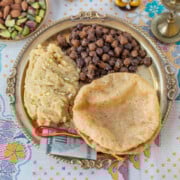
Ashtami Prasad - Halwa, Poori, and Kala Chana
Learn how to prepare the perfect Ashtami Prasad with these three classic recipes of sooji halwa, sookha kala chana, and puri, along with simple tips to get each dish just right.
Servings: 6
Ingredients
Sooji Recipe
- 1/2 cup Semolina (Sooji/Rava) fine
- 1/4 cup Ghee
- 1/3 cup Sugar can be increased to 1/2 cup or reduced to 1/4 cup depending on taste
- 1/2 cup Milk
- 1 1/2 cup Water reduce to 1 cup of water for a crumbly texture for sheera
- 1/4 teaspoon Cardamom powder (Elaichi)
- Saffron (Kesar) few strands
- 1/4 cup Nuts chopped, divided (cashews, almonds, pistachios, raisins)
Sookha Kala Chana Ingredients
- 2 cups Black Chickpeas (Kala Chana) rinsed & soaked in water for 6+ hours
- 1 teaspoon Salt adjust to taste
- 2 tablespoons Ghee or Oil
- 1 teaspoon Cumin seeds (Jeera)
- 2 cup Water use 1 cup for Instant Pot
- 2 teaspoons Coriander powder (Dhaniya powder)
- 1 teaspoon Ground Cumin (Jeera powder)
- 1 teaspoon Red Chili powder (Mirchi powder) adjust to taste
- 2 teaspoons Dry Mango powder (Amchur) or lime juice
- 1/4 cup Cilantro to garnish
Puri Ingredients
- 2 cups Whole Wheat Flour 360 grams
- 1 teaspoon Oil
- 1 teaspoon Salt adjust to taste
- 1/2 teaspoon Carom seeds (Ajwain) optional
- 1/2 to 3/4 cup Water or add as required
- Oil for deep frying, about 2 cups
Instructions
Making Sooji Halwa
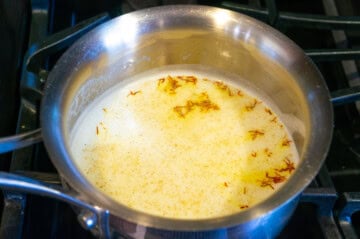
- In a small pot, combine the milk, water, sugar, ground cardamom, and saffron. Stir at regular intervals. Once the liquids are heated and the sugar has fully dissolved, turn off the heat. We don’t need to boil or thicken the mixture.
- At the same time, heat a heavy-bottomed pan on medium-low flame. Add sooji and ghee to the pan. You want to roast the sooji at a low temperature while stirring continuously. I like to roast the sooji till it is golden, but it is purely a matter of preference. You can roast to a lighter brown color or to a deep golden color.
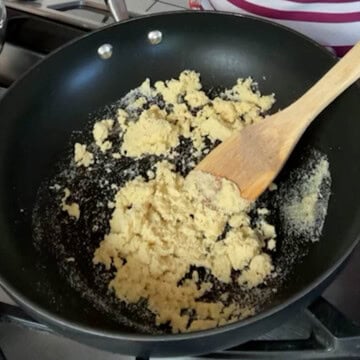
- Once the sooji is almost the desired golden color, add half of the nuts to the pan and roast them along with the semolina. Turn the flame to low as soon as the sooji turns golden.
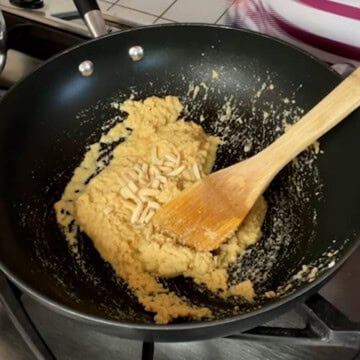
- Carefully pour the hot water and milk mixture into it while stirring continuously. Be careful, as there will be some splatter when you first pour, but keep stirring to avoid lumps.
- Keep stirring while the mixture combines and becomes a thick, dropping consistency. This should take 2-3 minutes. It should be a porridge-like consistency that can be easily served.
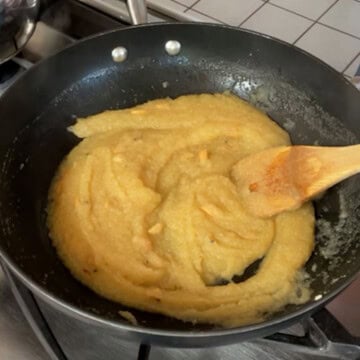
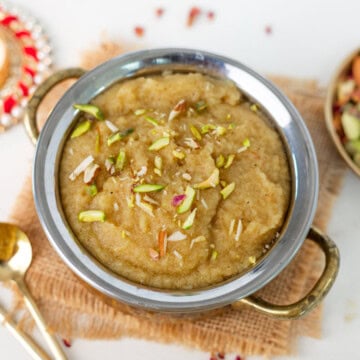
- Remove from the flame when it just begins to thicken. Garnish with the remaining nuts and serve it warm.
Making Kala Chana
- Drain the soaked chickpeas, then add them to a pressure cooker along with salt and 2 cups of water.
- Pressure cook the chickpeas in a stovetop pressure cooker on high heat. After the first whistle, reduce the heat to medium-low and let it cook for 20-22 minutes (6-7 whistles). Allow the pressure to release naturally, then open the lid. (If using an Instant Pot, use 1 cup of water and pressure cook for 30 minutes)
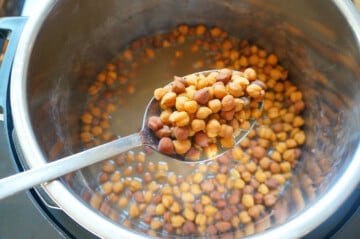
- Drain the chickpeas, but reserve the liquid. It can be used in roti dough or dals. We will also use some later when sautéing.
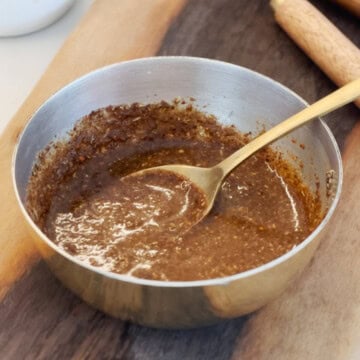
- In a small bowl, mix all the spices. Add some of the reserved chickpea water and mix with the spices until the mixture has a pouring consistency.
- Heat the oil in a pan over medium heat and add cumin seeds to it. Let them sizzle for about 30 seconds.
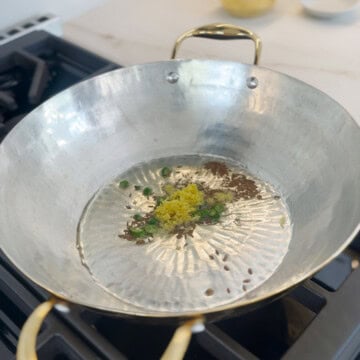
- Add the drained chickpeas and half a cup of the reserved water and mix well.
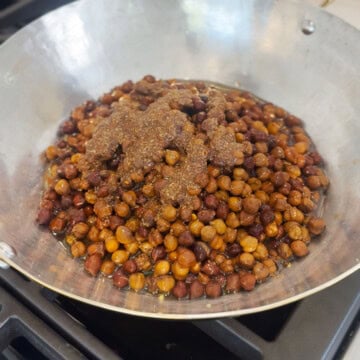
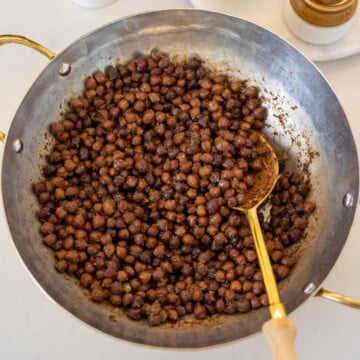
- Let the chickpeas cook for 5-7 minutes, then take them off the heat. The water will all be absorbed by this time. Garnish with cilantro.
Making Puri
- In a large bowl or on a flat plate with high edges, place the whole wheat flour. Add salt, carom seeds, and oil. Slowly start adding water and mix with your hands. Don’t add all the water at once. Keep adding water as needed while mixing.
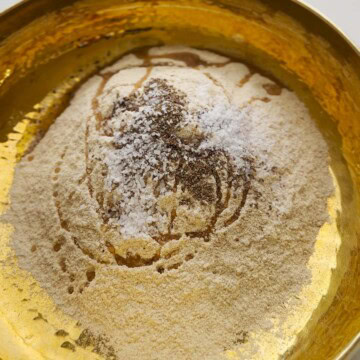
- Once the dough starts to form, do not add more water. The amount of water will vary depending on the brand of whole wheat flour. Knead well to form a smooth, uniform dough. The dough should not be too soft; it should be stiff and tight for poori.
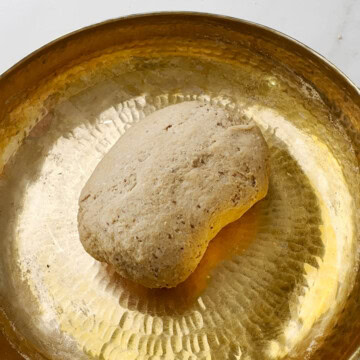
- Cover with a damp cloth or plastic wrap and let the dough rest for 5 minutes. (Note: Don't increase the resting time, as the dough hydrates more as it sits, which will result in oily pooris.)
- Once the resting time is done, knead the dough once again. Then make 20 equal-sized small dough balls. Keep the dough and balls covered during this time so they do not dry out.
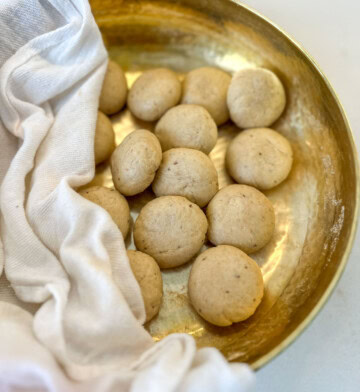
- While you are making the balls, heat oil in a deep frying pan or kadai.
- Take one dough ball and place it on the rolling board. Flatten with your fingers and apply a little oil (do not dust with flour). Roll it into a circle about 4-5 inches in diameter, applying even pressure on all sides, neither too thick nor too thin. (Thin poori might not puff properly and can become crispy)
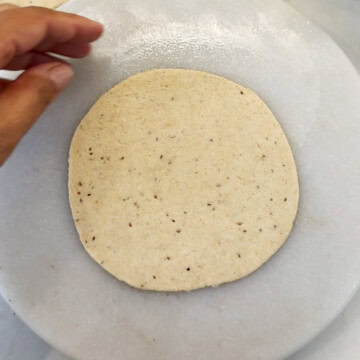
- Transfer the rolled puri to a plate or parchment paper. Roll all the pooris and line them on the plate.
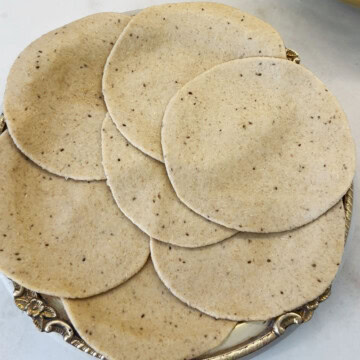
- Place the rolled poori on a plate and cover with a clean kitchen towel, so that they don’t dry up.
- The oil is ready when it is hot but not smoking. It should be heated to about 350°F or 180°C. You can test the oil by putting a tiny piece of dough. It should sizzle to the top if the oil is hot enough.
- Carefully add one rolled poori at a time into the oil. It should rise to the top of the oil. Gently press down on the poori with a slotted spoon; this helps it to puff evenly. Then flip over the poori with the slotted spoon and fry till both sides are golden brown.
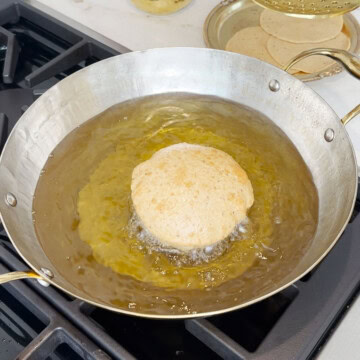
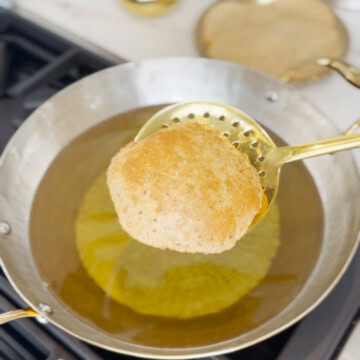
- Carefully take the puffed poori with a slotted spoon. Let any excess oil drain, then transfer to a plate lined with a paper towel. Repeat frying all the pooris.
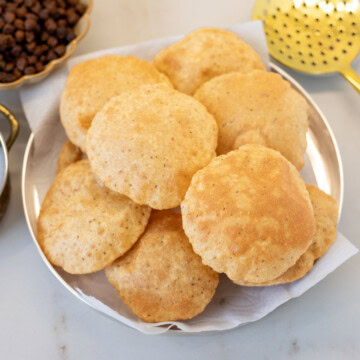
- Serve poori hot with suji ka halwa and sookha kala chana.
Nutrition
Calories: 647kcal | Carbohydrates: 95g | Protein: 22g | Fat: 22g | Saturated Fat: 9g | Polyunsaturated Fat: 4g | Monounsaturated Fat: 7g | Cholesterol: 34mg | Sodium: 814mg | Potassium: 845mg | Fiber: 17g | Sugar: 20g | Vitamin A: 236IU | Vitamin C: 3mg | Calcium: 128mg | Iron: 7mg